What Is a Trial Balance and How Do You Use It?

What Is a Trial Balance and How Do You Use It? A Complete Guide to Understanding and Preparing Trial Balances

A trial balance is one of the most fundamental tools in accounting. It helps verify that financial records are accurate by summarizing all ledger accounts and ensuring that total debits equal total credits.
Accountants use trial balances as a checkpoint in the accounting cycle, allowing them to detect errors before preparing financial statements such as the income statement or balance sheet.
Understanding how to prepare and interpret a trial balance is essential for:
Maintaining accurate financial records
Preventing accounting errors
Supporting financial reporting compliance
Preparing reliable financial statements
This guide explains everything you need to know about trial balances, including:
What a trial balance is and why it matters
How trial balances summarize ledger accounts
Step-by-step instructions for preparing a trial balance
Common trial balance errors and how to fix them
The relationship between trial balances and financial statements
How modern accounting software automates trial balances
Overview of the Trial Balance Process
What Is a Trial Balance? Definition and Purpose in Accounting
A trial balance is a financial report that lists the balances of all general ledger accounts at a specific moment in time.
Its main purpose is to verify that:
Total Debits = Total Credits
This equality confirms that the double-entry accounting system has been applied correctly.
Primary Purposes of a Trial Balance
A trial balance helps accountants:
Verify that transactions were recorded properly
Identify accounting errors before financial statements are prepared
Summarize all ledger account balances in one report
Provide a preliminary overview of the company's financial condition
Beyond error detection, trial balances provide an early financial snapshot of the business. By reviewing account balances, management can detect unusual patterns or unexpected financial changes before formal reports are finalized.
How Does a Trial Balance Summarize Ledger Accounts?
The trial balance summarizes all accounts recorded in the general ledger.
These accounts fall into five major categories:
Assets
Liabilities
Equity
Revenue
Expenses
Each account balance appears in either the debit column or credit column depending on its normal balance.
Typical Account Balance Types
Account Type | Normal Balance |
Assets | Debit |
Expenses | Debit |
Liabilities | Credit |
Equity | Credit |
Revenue | Credit |
This structure allows accountants to quickly evaluate whether the ledger balances follow the rules of double-entry accounting.
In addition to verifying accuracy, trial balances can support early financial analysis, including:
Liquidity ratio calculations
Profitability indicators
Debt level monitoring
These insights can help businesses identify potential financial issues before financial statements are finalized.
Why Must Debits Equal Credits in a Trial Balance?
The equality of debits and credits comes from the double-entry accounting system, which requires every transaction to affect at least two accounts.
For example:
Transaction | Debit | Credit |
Purchase equipment with cash | Equipment | Cash |
Because every transaction records both sides, the accounting equation remains balanced.
The Accounting Equation
Assets = Liabilities + Equity
If debits and credits do not match in a trial balance, it signals that:
A transaction was recorded incorrectly
A posting error occurred
An amount was entered incorrectly
Identifying these imbalances early helps prevent inaccurate financial reporting.
How To Prepare a Trial Balance
Step-by-Step Process with Examples
Preparing a trial balance involves several structured steps.
Step 1: Collect Ledger Account Balances
Accountants begin by extracting the ending balances of every general ledger account.
This includes accounts such as:
Cash
Accounts Receivable
Accounts Payable
Sales Revenue
Expenses
All transactions must be posted before preparing the trial balance.
Step 2: Classify Each Balance as Debit or Credit
Each account is assigned to the appropriate column.
Typical classification:
Debit Accounts | Credit Accounts |
Assets | Liabilities |
Expenses | Equity |
Revenue |
Step 3: List Accounts in Standard Order
Accounts are typically arranged in this order:
Assets
Liabilities
Equity
Revenues
Expenses
This standardized layout improves readability and simplifies error detection.
Step 4: Calculate Totals
Add the debit and credit columns separately.
If totals match, the trial balance is considered mathematically correct.
Step 5: Investigate Discrepancies
If the columns do not match, accountants must investigate.
Possible causes include:
Transposition errors
Incorrect posting amounts
Missing transactions
Mathematical mistakes
Standard Trial Balance Format and Layout
A trial balance usually follows a simple table format.
Account Name | Debit | Credit |
Cash | 10,000 | |
Accounts Receivable | 5,000 | |
Accounts Payable | 3,000 | |
Owner's Equity | 12,000 | |
Totals | 15,000 | 15,000 |
When totals match, the ledger is considered balanced.
Modern accounting software automatically generates trial balances, but understanding the manual format helps accountants interpret reports and troubleshoot errors.
Common Trial Balance Errors and How to Correct Them
Even with careful accounting practices, errors can occur.
Understanding these mistakes helps accountants quickly correct them.
Errors a Trial Balance Can Detect
Transposition Errors
Digits are reversed.
Example:
540 recorded instead of 450.
Arithmetic Errors
Incorrect addition or subtraction when calculating totals.
Single-Sided Entries
A transaction recorded on only one side of the ledger.
This violates double-entry accounting and causes imbalance.
Errors a Trial Balance Cannot Detect
Some errors do not affect debit-credit equality.
These include:
Errors of Omission
A transaction is completely missing from records.
Errors of Commission
A transaction is recorded in the wrong account but with correct debit and credit amounts.
Compensating Errors
Two separate errors cancel each other out.
Errors in Source Documents
Incorrect amounts originating from invoices or receipts.
How Adjusting Entries Fix Trial Balance Discrepancies
Adjusting entries correct discrepancies and ensure financial statements reflect accurate economic activity.
Common adjusting entries include:
Accrued expenses
Accrued revenue
Deferred revenue
Depreciation
Error corrections
Adjustments align financial records with the accrual accounting principle, ensuring revenues and expenses are recorded in the correct accounting period.

How Does a Trial Balance Relate to Financial Statements?
The trial balance provides the raw data used to prepare financial statements.
Trial Balance vs Balance Sheet
Feature | Trial Balance | Balance Sheet |
Purpose | Verify ledger accuracy | Present financial position |
Audience | Internal accounting tool | External stakeholders |
Format | List of account balances | Structured financial statement |
The balance sheet uses adjusted balances derived from the trial balance.
Trial Balance in the Accounting Cycle
The accounting cycle follows a structured process.
Record transactions
Post to general ledger
Prepare trial balance
Adjust entries
Prepare financial statements
Close accounts
The trial balance acts as a verification checkpoint before financial reporting.

Why Trial Balance Is Important for Account Reconciliation
Trial balances play an essential role in financial reconciliation.
Accountants compare trial balances with:
Bank statements
Accounts receivable reports
Accounts payable records
Financial ledgers
This process ensures all financial transactions are recorded accurately.
Regular reconciliation helps:
Prevent fraud
Detect errors early
Improve financial transparency
Support audit readiness
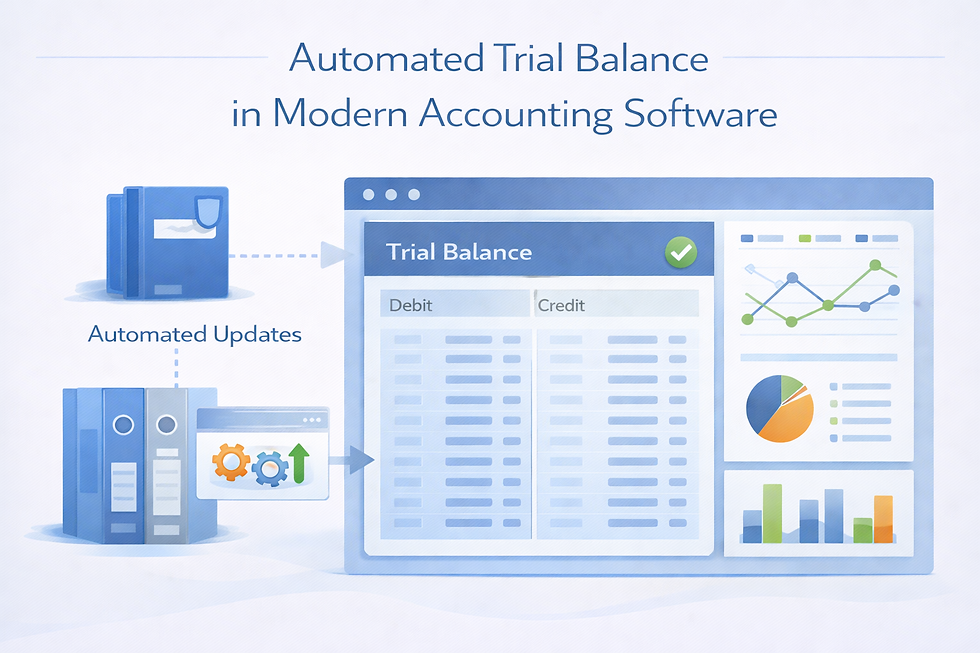
Trial Balance in Modern Accounting Software
Today, most businesses prepare trial balances using accounting software or ERP systems.
Automation improves accuracy and efficiency.
Benefits of Trial Balance Automation
Automated systems provide several advantages.
Reduced manual data entry
Faster financial reporting
Real-time financial updates
Improved audit trails
Lower risk of calculation errors
Businesses using modern accounting platforms can generate trial balances instantly while maintaining full visibility into ledger activity.
Strategic Value of Trial Balances Beyond Error Detection
While trial balances are often viewed as an error detection tool, they also provide valuable financial insight.
By analyzing trial balance trends over time, businesses can detect:
unusual expense growth
declining revenue accounts
increasing debt balances
cash flow changes
Organizations can also use trial balance data to calculate early financial indicators such as:
current ratio
debt-to-equity ratio
profit margins
When integrated with analytics tools, trial balances can support financial forecasting and strategic planning.
This transforms the trial balance from a simple accounting report into a powerful financial management tool.
Key Takeaways
A trial balance is an essential component of the accounting cycle.
It ensures financial accuracy by verifying that:
Total Debits = Total Credits
Beyond its technical purpose, the trial balance also helps organizations:
detect accounting errors early
prepare accurate financial statements
support financial analysis and decision-making
maintain compliance with accounting standards
Businesses that regularly analyze their trial balances gain greater financial visibility, stronger internal controls, and improved reporting accuracy.
Author Bio
Miranda Kishel, MBA, CVA, CBEC, MAFF, MSCTA, is an award-winning business strategist, valuation analyst, and founder of Development Theory, where she helps small business owners unlock growth through tax advisory, forensic accounting, strategic planning, business valuation, growth consulting, and exit planning services.
With advanced credentials in valuation, financial forensics, and Main Street tax strategy, Miranda specializes in translating “big firm” practices into practical, small business owner-friendly guidance that supports sustainable growth and wealth creation. She has been recognized as one of NACVA’s 30 Under 30, her firm was named a Top 100 Small Business Services Firm, and her work has been featured in outlets including Forbes, Yahoo! Finance, and Entrepreneur. Learn more about her approach at https://www.valueplanningreports.com/meet-miranda-kishel